Tank freezing: predicting the stress ice puts on the walls
Freezing water gains 8.7% in volume. In a closed tank, this expansion pressurizes the walls: an iterative fluid-structure coupling predicts stress and deformation as a function of the filling level.
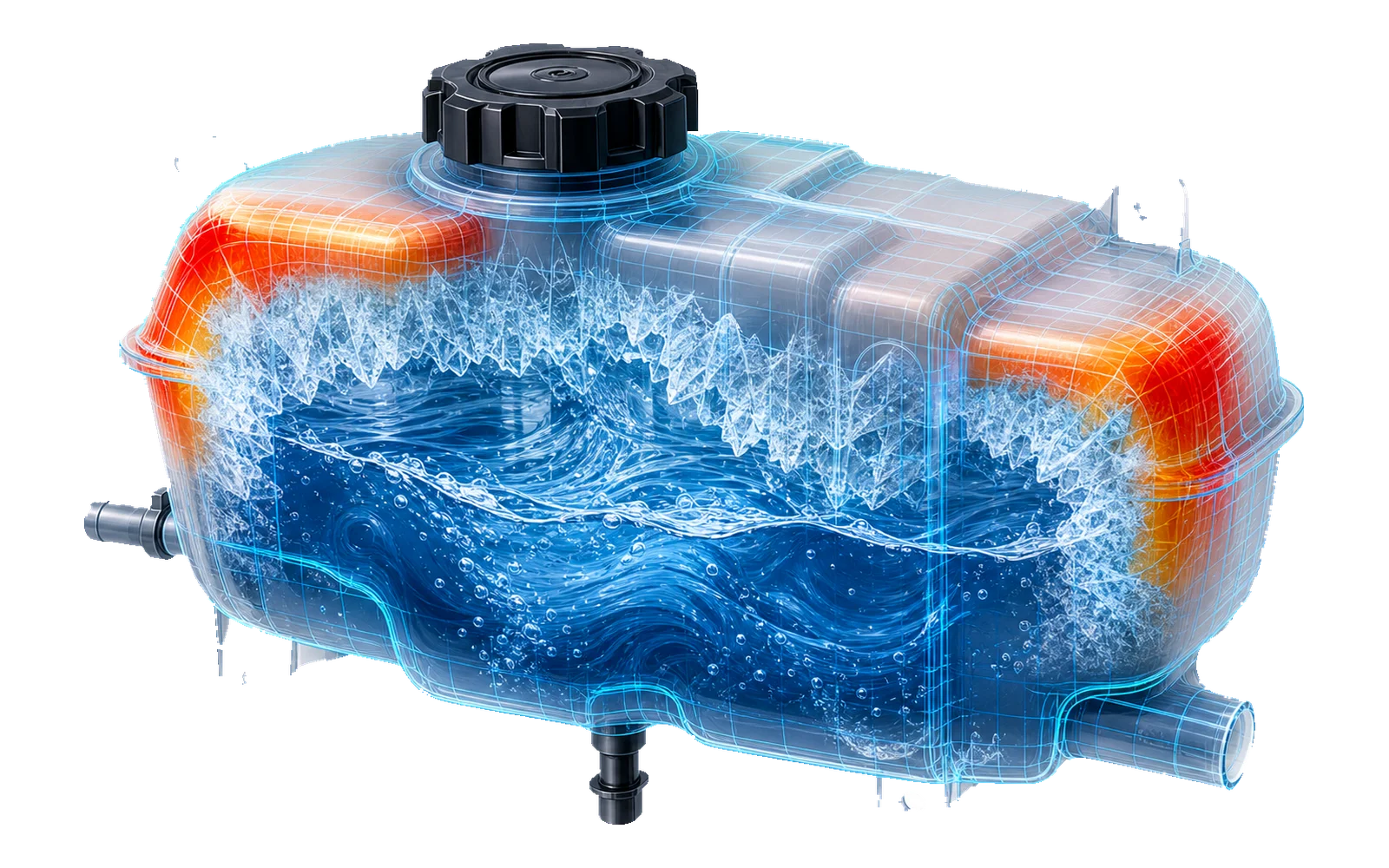
The challenge
When water freezes, its volume grows by about 8.7%. In a closed, partially filled HDPE tank, this expansion pressurizes the walls, while the material's plastic zone starts between 24 and 33 MPa. The question to settle: from which filling level does freezing become critical for the tank's integrity?
The fluid-structure coupling
The difficulty is that pressure depends on the available volume, which itself depends on wall deformation. We therefore built an iterative loop between two computations:
- Fluid side: multiphase solidification tracking the liquid fraction, the gas headspace treated as an ideal gas; user functions recompute water and ice volumes and the associated pressure at every time step
- Structural side: nonlinear computation with large displacements and strains, walls fixed in three areas
- Pressure deforms the tank, the deformed shape updates the volume, which corrects the pressure at the next step
- Dedicated meshes: 3,094 surface and 39,015 volume elements; walls at -13.45°C, fluid initially at +1.85°C
Results
- Reference case filled at 77%: 82% of the liquid solidified over 21,759 simulated seconds (68 hours of computation)
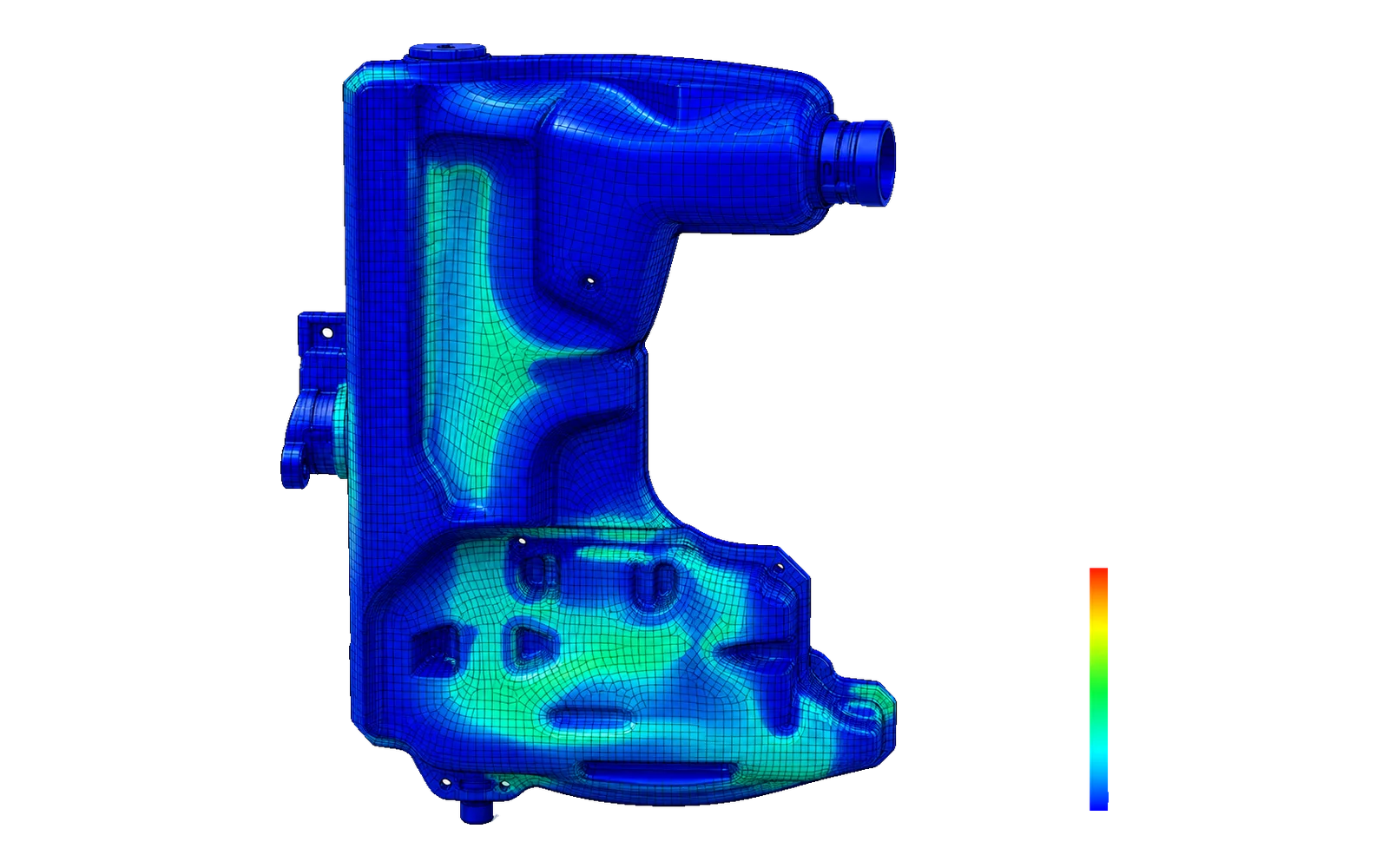
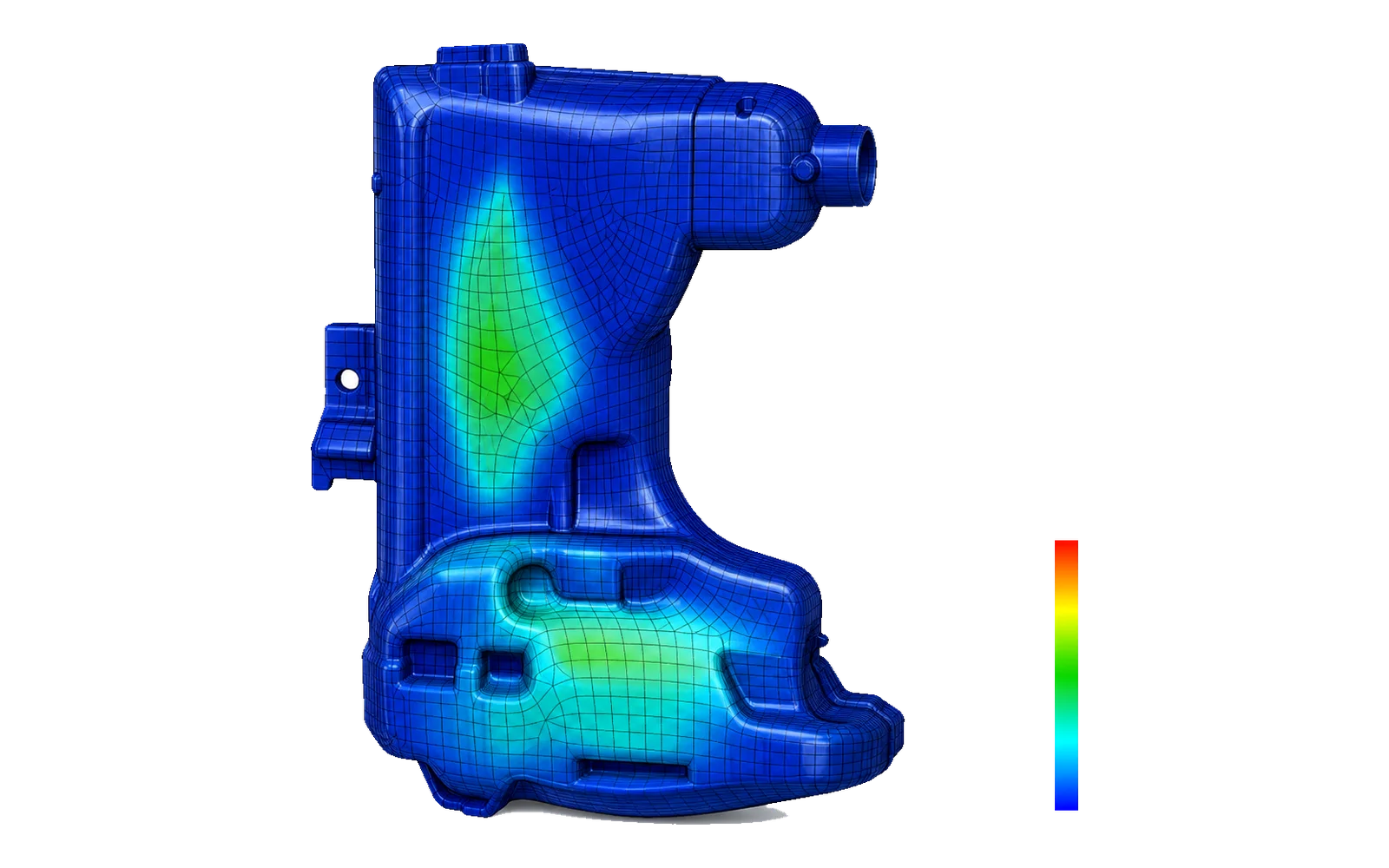
- At 100% filling: maximum stress of 66.5 MPa and 19.9 mm displacement, for an 8.69% water expansion
- At 85.6%: 42.0 MPa and 14.5 mm; critical filling levels versus HDPE plasticity identified
- Physical model validated for filling levels from 62 to 100%
Limits
Deliberately restrictive boundary conditions make the results upper bounds, hence conservative for sizing. The method extends to other tank geometries and other liquids.