External aerodynamics: a complete OpenFOAM pipeline, from CAD to coefficients
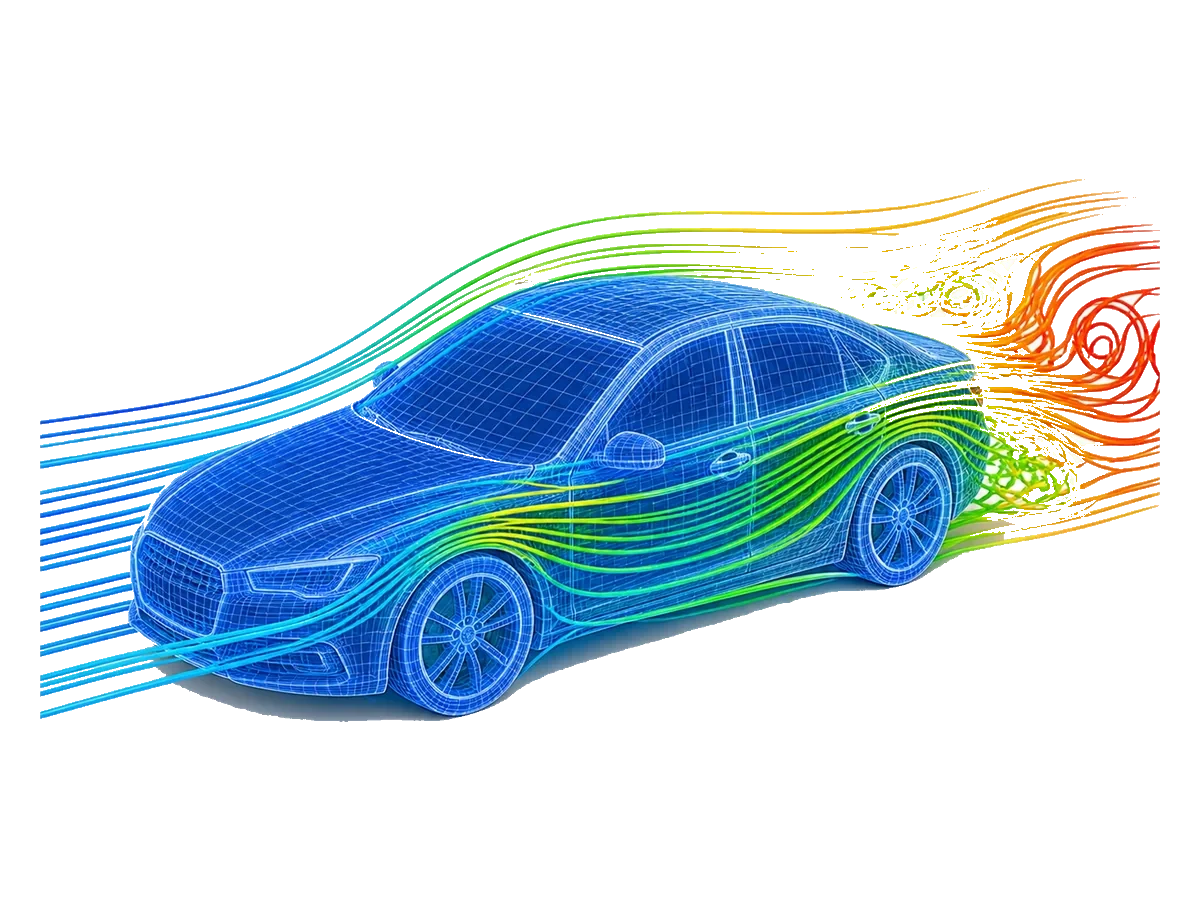
A virtual wind tunnel at 140 km/h with moving ground, rotating wheels and resolved rims: a reproducible pipeline delivering a complete, well-converged aerodynamic force torsor, within about 3% of a commercial reference simulation.
The challenge
Assess the drag and lift of a vehicle at 140 km/h (38.89 m/s) and compare geometry variants without manual rework, under road-representative conditions: moving ground, rotating wheels and geometrically resolved rims, each pierced by five through windows in which the fluid is actually meshed.
Methodology
Steady incompressible RANS computation with the k-ω SST turbulence model in OpenFOAM. The geometry is prepared as two watertight sets: the body (242,142 triangles) and the wheels (207,700 triangles), meshed hex-dominant for a total of about 15.6 million cells.
- Velocity inlet, zero-pressure outlet, slip roof and side walls
- Ground handled as a moving belt at vehicle speed, completed by a fixed ground upstream
- Wheels in a rotating frame (MRF, ω = -122.1 rad/s), rotating zones created during meshing
- Wheel/ground contact cleaned up by four contact blocks, removing the sliver cells that cause spurious overspeed
- Bounded higher-order schemes for velocity, multigrid for pressure, residuals controlled at 10⁻⁴, 5,000 iterations
Results
- Cx = 0.348 (SCx = 0.760 m²), Cz = 0.175 (SCz = 0.382 m²), Cy = 0.034 and Cm = -0.081, averaged over the last 200 iterations
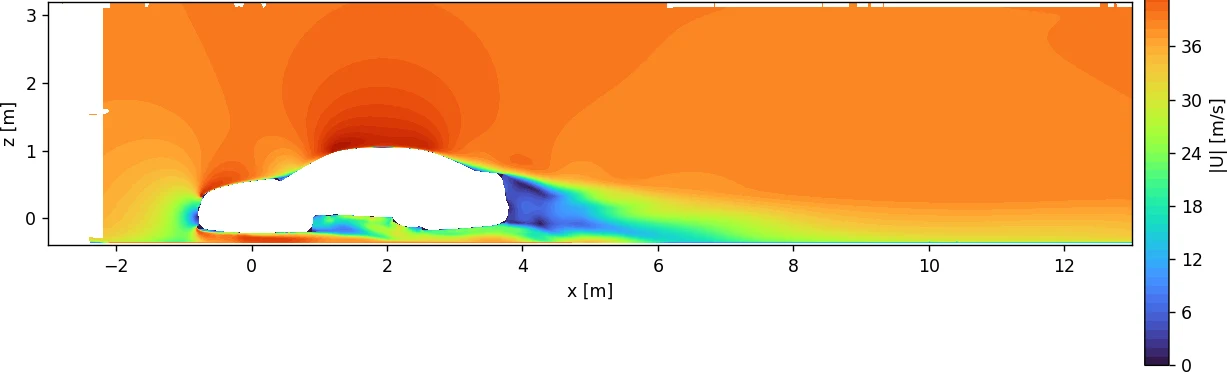
- Physics recovered: front stagnation, roof overspeed around 49 m/s, low-velocity wake
- About 3% deviation on drag versus a reference simulation run with a commercial solver, lift also matched
- Pipeline rerunnable as is on every geometry variant
Limits and next steps
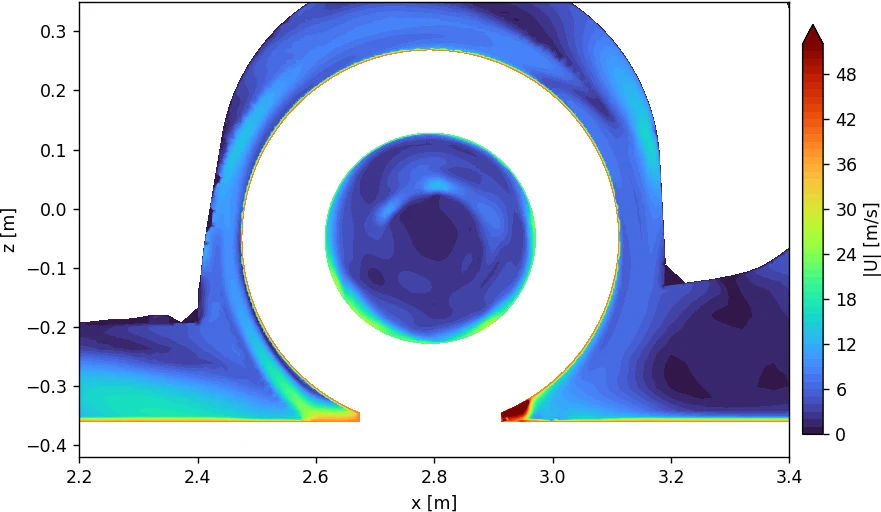
Air trapped in the rotating rim cavities is locally oversped: an intrinsic limit of the MRF approach (frozen rotor), with no effect on the global force torsor. A transient sliding mesh would remove it if higher local accuracy became necessary.